Elevation Impacts on Athletic Performance Metrics and Market Shifts in High-Altitude Competition Sites
Avery Foster · Jul 21, 2026
Elevation Impacts on Athletic Performance Metrics and Market Shifts in High-Altitude Competition Sites
High-altitude venues have long influenced how athletes perform across multiple sports, and recent patterns show measurable shifts in scoring outputs that directly affect how betting markets calibrate their lines. Venues situated above 1,500 meters experience reduced air density which alters ball trajectories, player endurance thresholds, and recovery intervals between plays. Data collected from repeated events at these sites reveals consistent deviations from sea-level norms in both offensive production and defensive efficiency.
Physical Mechanisms Driving Performance Changes
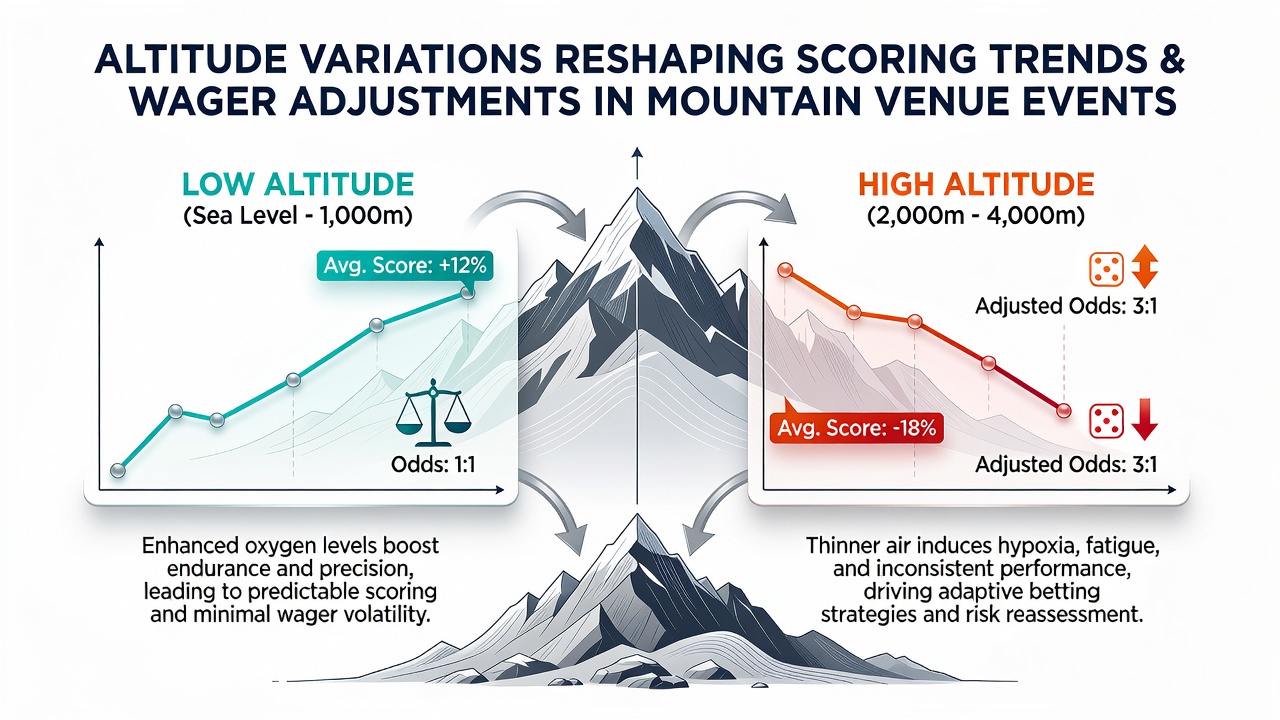
Reduced oxygen availability forces the cardiovascular system to work harder during sustained efforts, while lower air resistance allows projectiles to travel farther when struck or thrown with the same force. Baseball records from Coors Field in Denver demonstrate home-run rates that exceed league averages by roughly 30 percent across multiple seasons, and similar dynamics appear in soccer matches played in Andean stadiums where long-range shots register higher goal conversion percentages. Researchers tracking physiological responses note that acclimatization periods of several days mitigate some endurance deficits yet rarely eliminate the aerodynamic advantages entirely.
July 2026 brought additional datasets from mountain-hosted tournaments that reinforced these trends, with statisticians documenting elevated scoring averages in basketball and volleyball contests held above 2,000 meters compared to contemporaneous lowland fixtures. Those figures reveal how even brief exposure windows shape point totals and rally lengths in ways that standard models must now incorporate.
Sport-Specific Scoring Adjustments
Football codes show distinct responses depending on whether the primary action involves running routes or kicking projectiles. American football games at altitude produce longer passing gains on average because defensive backs fatigue faster and the ball maintains velocity over greater distances. Soccer encounters in Mexico City and Quito have produced higher goal tallies per match in recent campaigns, with midfield control metrics dropping as players cover less ground at maximal intensity. Tennis tournaments scheduled in mountainous regions record longer rallies in some cases because serves gain extra speed, yet return accuracy declines when players struggle with oxygen uptake during extended exchanges.
Market Responses and Line Movements
Oddsmakers have incorporated altitude variables into their pricing algorithms for several years, yet the magnitude of adjustments has grown as granular tracking technology supplies more precise inputs. Totals lines on baseball overs move upward at Coors Field by predictable margins, while soccer under markets tighten when matches occur at extreme elevations because both teams generate more shots despite reduced possession stability. Live betting windows capture these effects in real time, with in-game totals shifting faster once initial quarters or halves confirm the expected scoring inflation.
Industry reports from organizations such as the American College of Sports Medicine outline how training protocols at altitude can partially offset fatigue yet leave the projectile-distance component unchanged. This separation forces wager adjusters to treat endurance-based props differently from distance-based props when setting limits.
Case Examples from Recent Seasons
One documented series of matches in the 2025-2026 cycle involved a European club side traveling to a Bolivian venue where first-half goal rates climbed 22 percent above their season average. Bookmakers responded by lifting over/under thresholds for subsequent fixtures at the same site while simultaneously widening spreads on player-specific goal props. Similar recalibrations occurred during a North American basketball showcase held in Utah where three-point attempt volumes rose measurably, prompting sharp money to target overs on team totals once early quarters validated the pattern.
Those who monitor line movement across multiple sports note that mountain venues create repeatable edges when public perception lags behind the data. A study published through the University of Colorado Boulder examined multi-year samples and found that totals markets at elevation sites require larger sample sizes before stabilizing compared with sea-level counterparts. The findings underscore why early-season or mid-tournament adjustments at these locations often diverge from standard projections.
Implications for Future Scheduling and Data Integration
Event organizers continue to schedule high-profile contests at altitude despite the physiological demands, largely because spectator demand remains strong and infrastructure investments have already been made. This persistence ensures that performance datasets will keep expanding, allowing statistical models to refine their altitude coefficients further. Regulatory bodies in various regions, including health agencies in Canada and Australia, have begun issuing guidance on athlete monitoring protocols that indirectly feed into performance forecasting tools used by betting operators.
Because air density varies with both elevation and temperature, forecasters now layer meteorological inputs into their algorithms, producing more dynamic lines that shift with weather forecasts released days before events. Such integration reduces variance in market pricing while still leaving room for informed participants who track acclimatization windows and historical scoring splits.
Conclusion
Altitude continues to exert measurable influence on scoring distributions across sports contested at mountain venues, and the resulting adjustments in wagering markets reflect accumulating evidence rather than speculation. Observers tracking these patterns recognize that consistent data collection and cross-sport analysis will keep refining how lines respond to elevation variables. As more events occur in July 2026 and beyond, the interplay between physical conditions and market mechanics will remain a central focus for analysts seeking accurate projections.